Transform text into sarcastic aLtErNaTiNg cAsE, SpongeBob mocking cadence, double-beat pairs, or phonetic vowel/consonant patterns with automatic URL protection and sans-serif I/l homoglyph disambiguation.
Follow the five visual steps below to generate alternating caps, select SpongeBob mocking cadences, activate homoglyph guards, and copy formatted text:
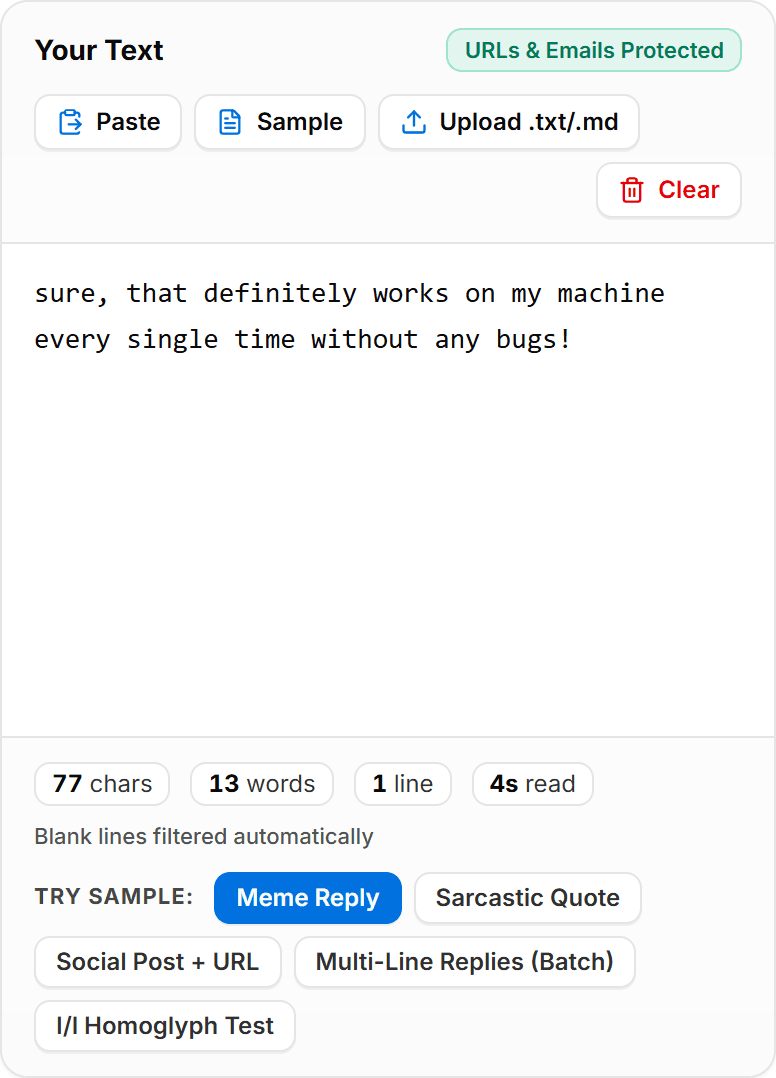
Mobile Input Workspace: Type, paste, or upload single sentences or batch multi-line lists with live text counters and URL protection.
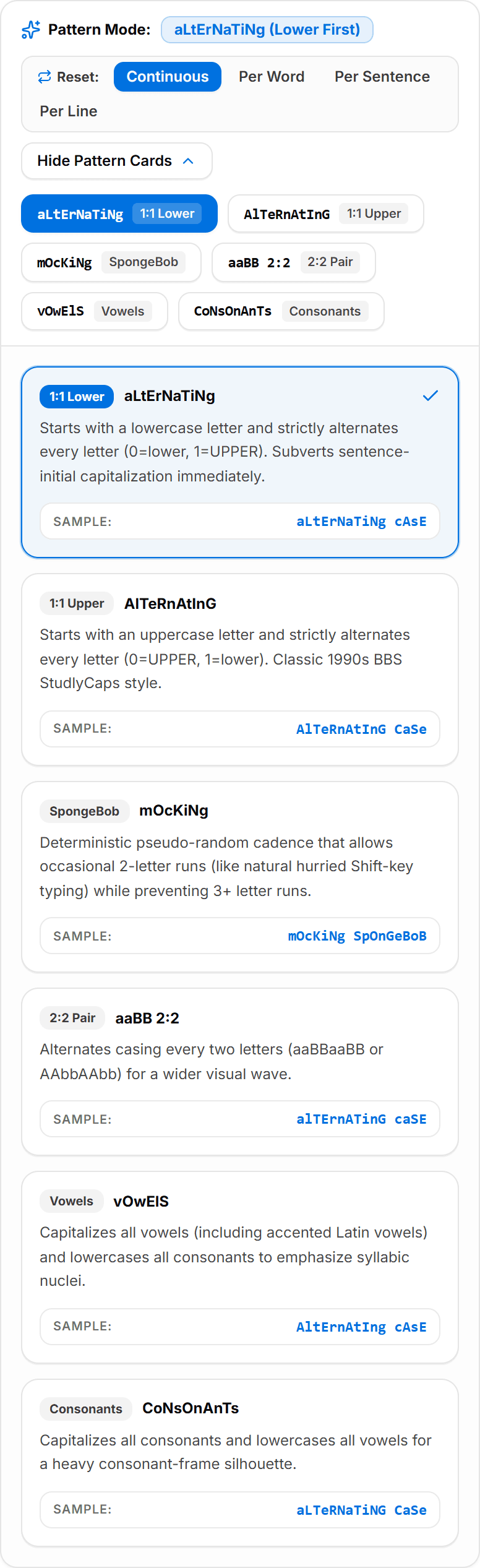
Pattern & Scope Toolbar: Switch between 6 distinct alternating cadence modes and configure sequence reset boundaries.
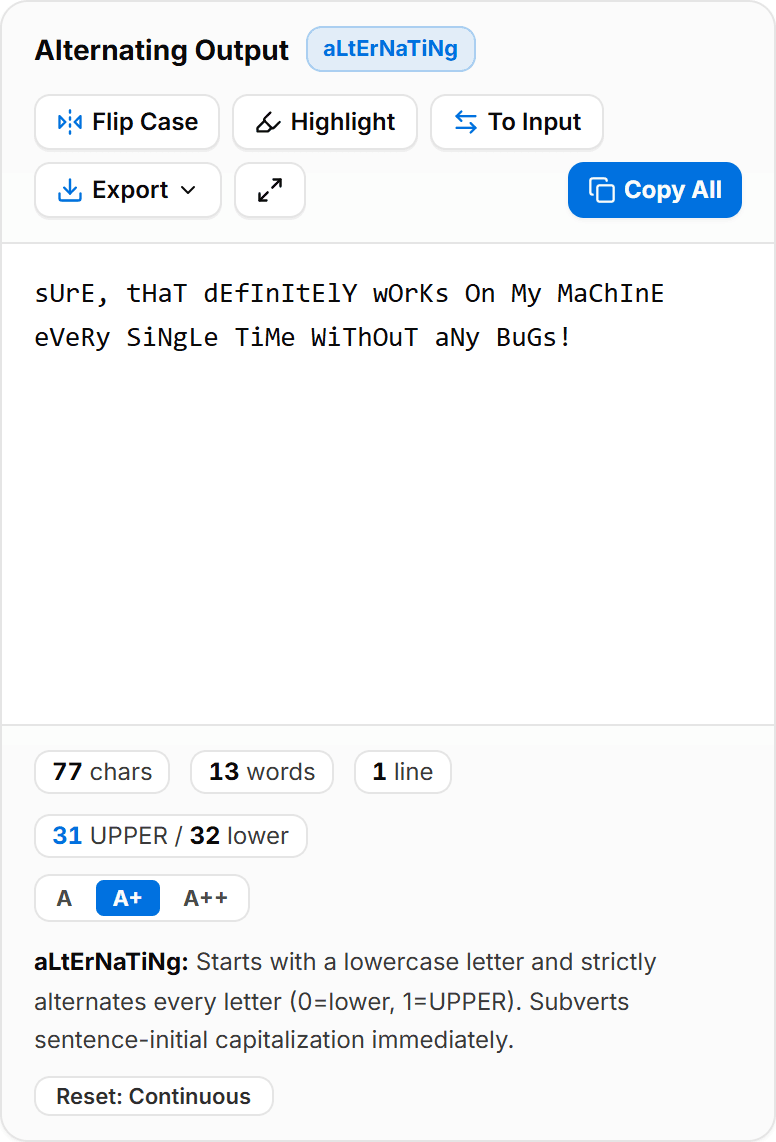
Studio Output Card: Verify alternating rhythm, invert starting polarity with Flip Case, highlight uppercase letters, and copy with 1 click.
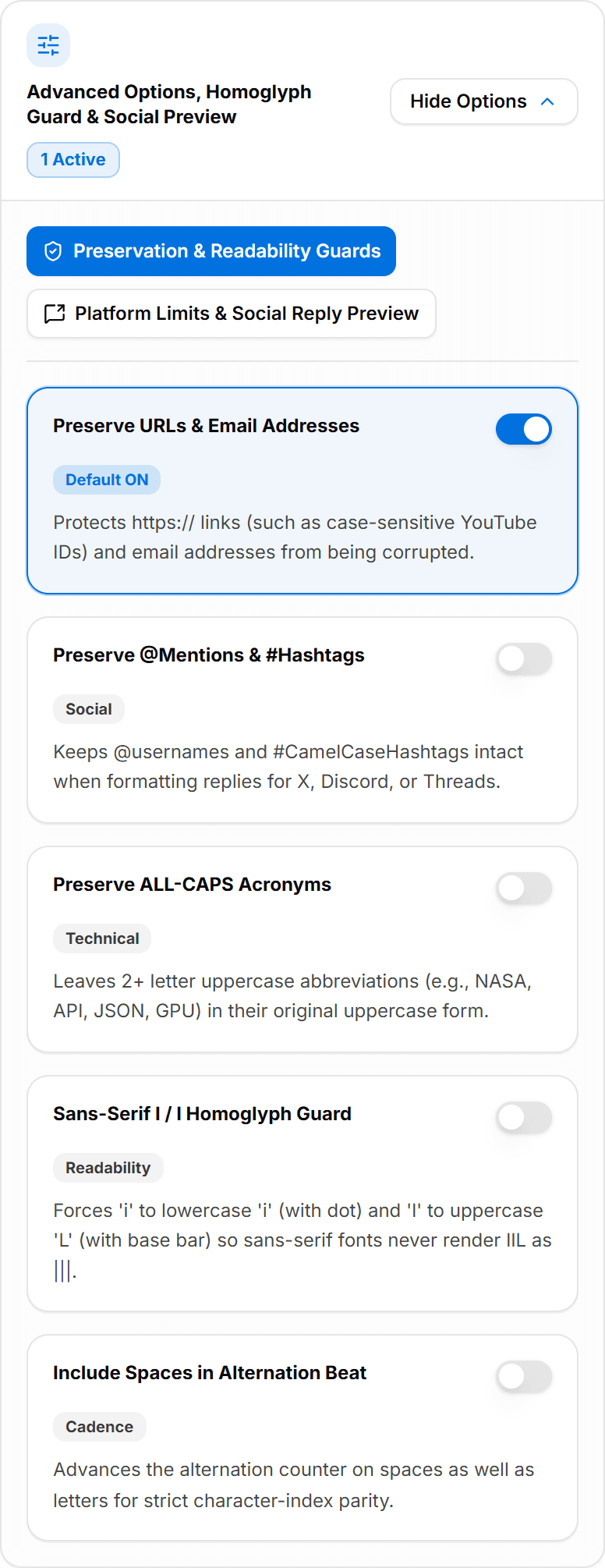
Advanced Controls & Homoglyph Guard: Protect delicate links, preserve uppercase acronyms, eliminate I/l confusion, and preview social cards.
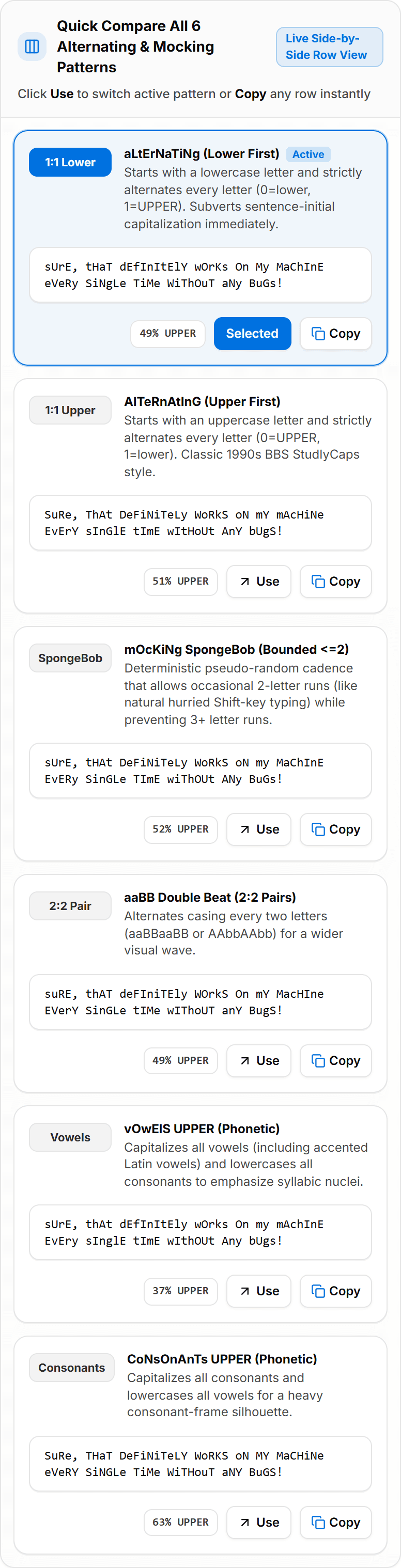
Live Multi-Pattern Comparison: View your text transformed across all 6 cadence styles simultaneously with 1-tap Use and Copy buttons.
Peer-reviewed cognitive findings on how unpredictable letter heights disrupt fluent reading to simulate sarcastic prosody.
During fluent reading, the eye executes 20–35ms saccades across familiar word shapes. Alternating case (e.g., wOrK vs. work) disrupts word boundary identification, increasing average fixation durations by 18% to 28% and triggering frequent regressive saccades.
According to Coltheart's Dual-Route Cascaded Model of reading, alternating case disables the fast direct orthographic route (stored visual word recognition in the VWFA). The brain is forced onto the slower indirect sub-lexical phonological route, sounding out the word letter-by-letter.
As linguist Gretchen McCulloch explains in Because Internet (2019), and as verified in CMC production studies (Tweeting Out Loud, 2021), slowing down lexical access blocks a sincere inner-voice reading. Readers map the visual up-and-down jitter onto an uneven, sing-song pitch contour—the exact acoustic profile of verbal mockery.
Detailed rules, input/output transformations, and ideal use cases for every mode in this studio.
Index 0 = lowercase, Index 1 = UPPERCASE (strict 1:1 letter parity).
Best for: Canonical Mocking SpongeBob replies, sarcastic quotes, subverting sentence-initial caps.
Index 0 = UPPERCASE, Index 1 = lowercase (strict 1:1 letter parity).
Best for: Classic 1980s–1990s BBS StudlyCaps, display names, stylized gamer tags.
Deterministic hash with a hard cap of <= 2 consecutive same-case letters.
Best for: Natural hurried Shift-key cadence that avoids 3+ letter runs (never reads like a typo).
Pairs of 2 lowercase letters followed by 2 uppercase letters (aaBBaaBB).
Best for: Wider rhythmic wave for banners, aesthetic headers, and playful nicknames.
All vowels (A, E, I, O, U + accented Latin vowels) uppercase; consonants lowercase.
Best for: Highlighting syllabic nuclei and vocalic stress in phonetic or creative text.
All consonants uppercase; all vowels lowercase.
Best for: Emphasizing consonant cluster frames while keeping vowel interiors compact.
Control where the alternating beat restarts without breaking contractions like don't or I'm.
Runs a single uninterrupted letter counter across spaces, punctuation, and line breaks so the rhythm never resets.
Resets the counter to 0 at each word boundary while treating internal apostrophes ('don't', 'i'm') as part of the same word.
Resets the counter to 0 after sentence terminators (., !, ?, …) and line breaks so every sentence begins on the same beat.
Resets the counter to 0 on each newline—essential for batch username generation, line-by-line lyric styling, and tabular data.
From 1980s BBS StudlyCaps to modern sans-serif typography and screen-reader behavior.
Cataloged in Eric S. Raymond's The Jargon File as StudlyCaps (or sticky caps), alternating capitalization originated on 1980s bulletin board systems (BBS) and Warez NFO files as a subcultural status marker. In May 2017, a still frame from SpongeBob SquarePants Season 9, Episode 189 (“Little Yellow Book”) went viral on X/Twitter, permanently transforming aLtErNaTiNg cAsE into the global typographic signifier for mockery.
In neo-grotesque sans-serif fonts (Inter, Roboto, Helvetica, Arial) used across X, Discord, Reddit, and Instagram, capital I (U+0049) and lowercase l (U+006C) are indistinguishable vertical strokes. Our I / l Homoglyph Guard keeps i dotted and L footed.
Assistive screen readers (NVDA, JAWS, Apple VoiceOver) use mid-word uppercase transitions to split camelCase identifiers or detect acronyms—meaning hElLo may be spoken as fragmented syllables. Keep alternating caps to punchy social quotes, and use our 31-format Case Converter for standard prose, academic titles, or developer identifiers.
Answers to common questions about alternating caps, SpongeBob cadence, homoglyph guards, and visual word recognition.
aLtErNaTiNg: Starts with a lowercase letter and strictly alternates every letter (0=lower, 1=UPPER). Subverts sentence-initial capitalization immediately.
Starts with a lowercase letter and strictly alternates every letter (0=lower, 1=UPPER). Subverts sentence-initial capitalization immediately.
Starts with an uppercase letter and strictly alternates every letter (0=UPPER, 1=lower). Classic 1990s BBS StudlyCaps style.
Deterministic pseudo-random cadence that allows occasional 2-letter runs (like natural hurried Shift-key typing) while preventing 3+ letter runs.
Alternates casing every two letters (aaBBaaBB or AAbbAAbb) for a wider visual wave.
Capitalizes all vowels (including accented Latin vowels) and lowercases all consonants to emphasize syllabic nuclei.
Capitalizes all consonants and lowercases all vowels for a heavy consonant-frame silhouette.
