Transform prose, headlines, and code identifiers across 31 case formats— including 11 writing & Unicode styles, 8 editorial style-guide title cases (Chicago 18th, AP, APA 7th, MLA 9th, AMA, IEEE, Bluebook, NYT), and 12 developer naming conventions (camelCase, PascalCase, snake_case, kebab-case) with automatic URL, email, and 220+ brand preservation.
Follow the five visual steps below to convert text, select developer naming conventions, verify token preservation, and compare 31 case formats simultaneously:
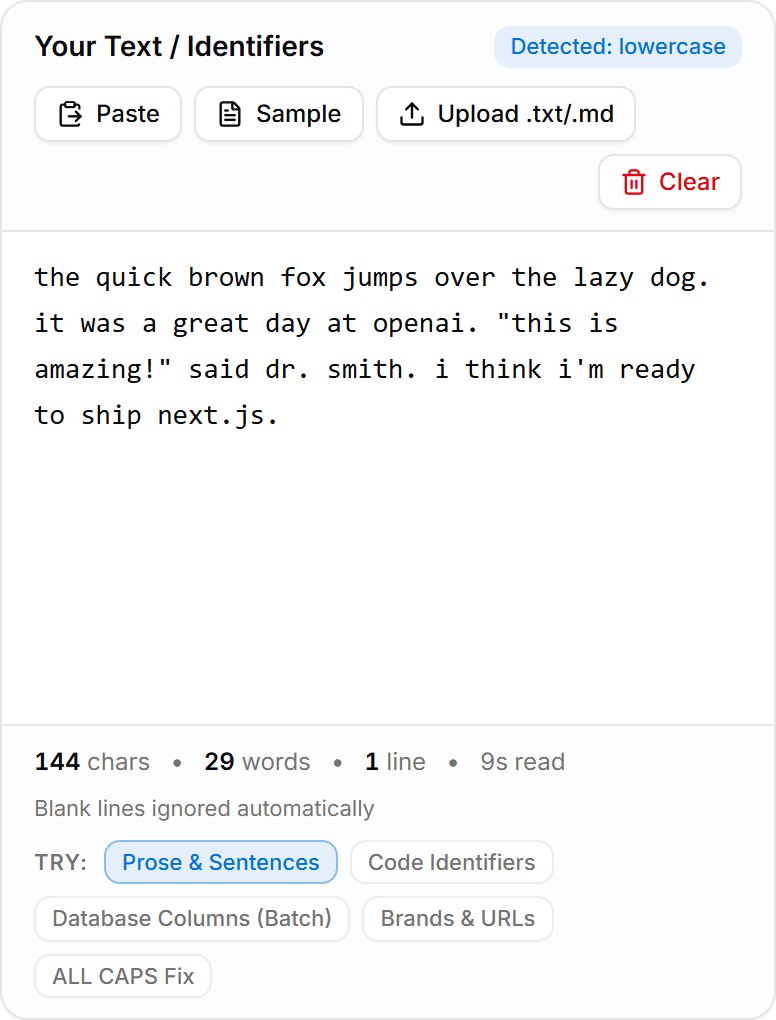
Mobile Input Workspace: Type, paste, or upload single identifiers or batch multi-line lists with live text counters and auto-case detection.
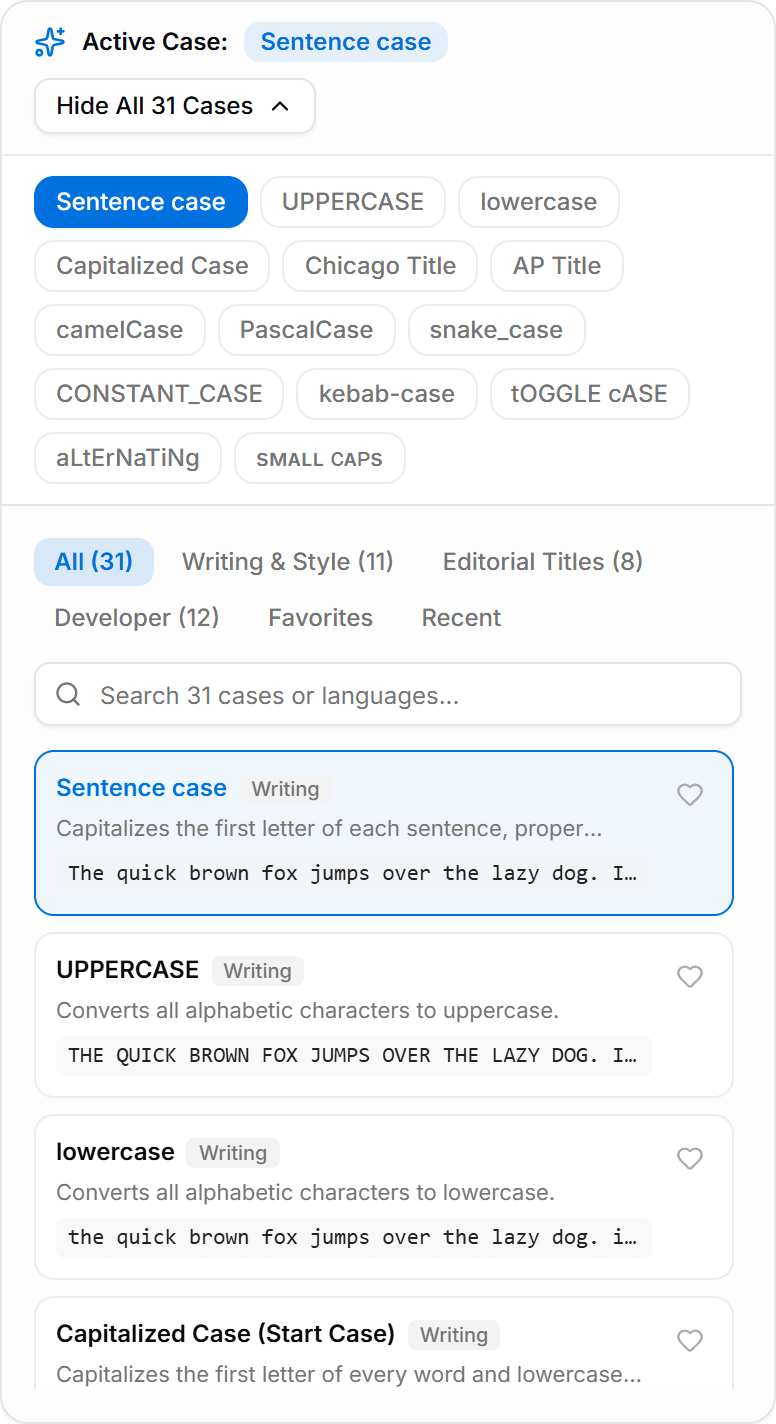
Case Selection Drawer: Browse 31 case formats grouped by category, filter by programming language, and star your favorites.
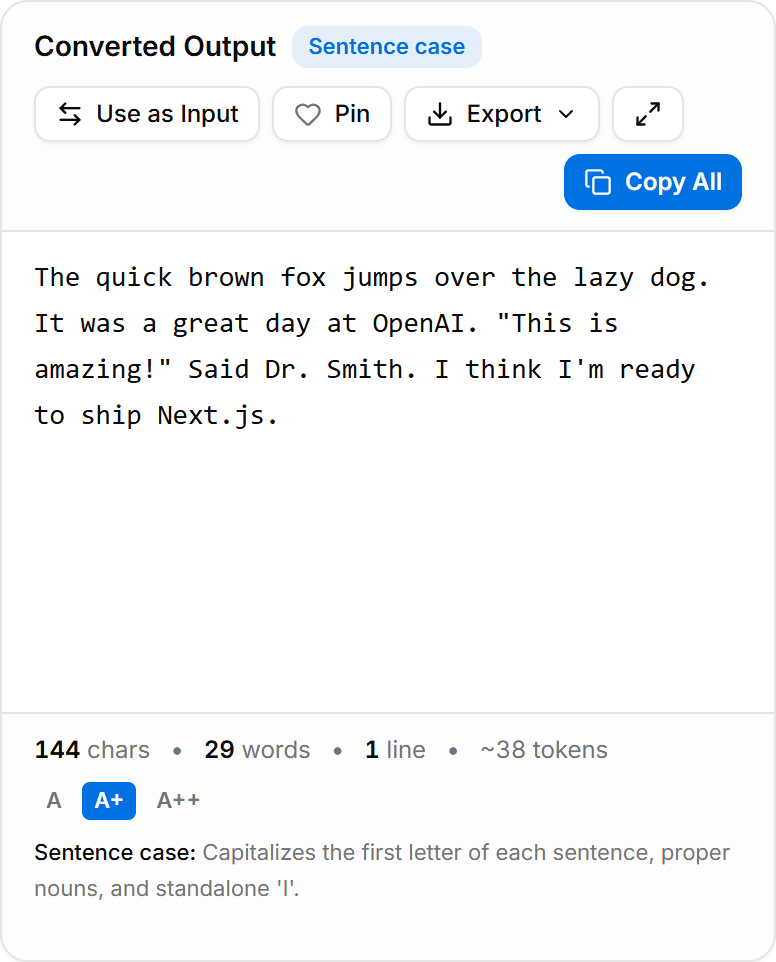
Studio Output Card: Verify converted casing, adjust preview font scale for mobile readability, export to TXT/MD/CSV, and copy with 1 click.
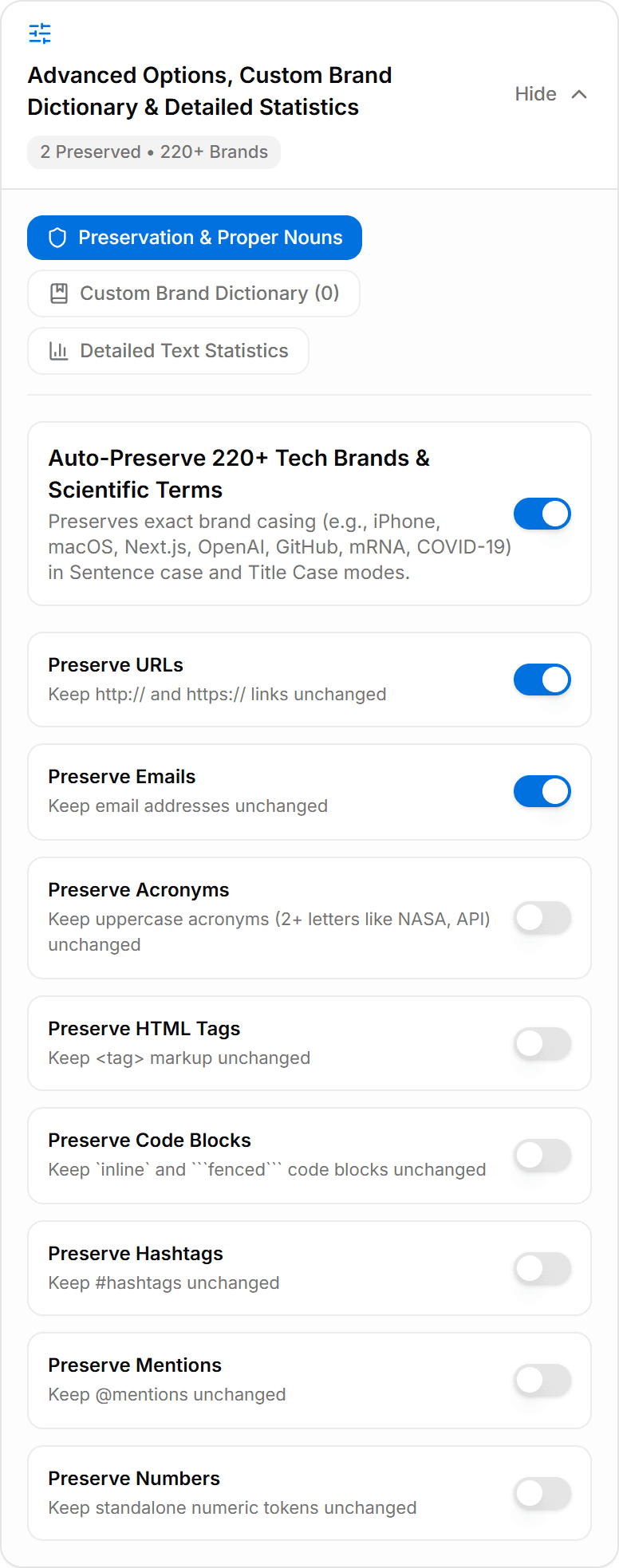
Advanced Token Preservation: Protect delicate URLs, emails, tech brand casing, and acronyms from accidental distortion.

Multi-Format Matrix: Compare your text converted across all 31 cases simultaneously in stacked high-contrast rows.
From fixing accidental Caps Lock typing to generating clean CSS kebab-case, SQL database identifiers, and academic title cases, this studio supports 31 distinct transformations divided into three specialized categories.
Sentence case, UPPERCASE, lowercase, Capitalized Case, Title Case, tOGGLE cASE, aLtErNaTiNg CaSe, mOcKiNg CaSe, sᴍᴀʟʟ ᴄᴀᴘs, Fullwidth, and InVeRsE cAsE.
Chicago 18th (§8.160), AP 57th, APA 7th (§6.17), MLA 9th (§2.90), AMA 11th, IEEE, Bluebook Rule 8, and New York Times style guides.
camelCase, PascalCase, snake_case, CONSTANT_CASE, kebab-case, Train-Case, dot.case, path/case, flatcase, COBOL-CASE, Ada_Case, and SEO URI Slugs.
Grammar-aware transformations that preserve acronyms, email addresses, and punctuation.
| Style | Transformation Rule |
|---|---|
| Sentence case | Capitalizes the first letter of each sentence (even after quotes/brackets), standalone 'I', titles ('Dr. Smith'), and 220+ proper nouns while ignoring abbreviations ('e.g.', 'U.S.'). |
| UPPERCASE | Converts every letter to uppercase while leaving preserved URLs, emails, or code spans intact. |
| lowercase | Converts all characters to lowercase while protecting preserved patterns like email addresses and URLs. |
| Capitalized Case (Start Case) | Capitalizes the first letter of every word without breaking contractions ('Don't', never 'Don'T'). |
| Title Case (General) | Capitalizes major words and first/last words of titles and subtitles; lowercases articles, conjunctions, and short prepositions. |
| tOGGLE cASE | Inverts the casing of every letter—ideal for fixing accidental Caps Lock typing. |
| aLtErNaTiNg CaSe | Strictly alternates lowercase (even letter index) and uppercase (odd letter index), skipping spaces and punctuation. |
| mOcKiNg CaSe | Applies deterministic pseudo-random SpongeBob-style casing so the same input produces stable, repeatable output. |
| sᴍᴀʟʟ ᴄᴀᴘs | Maps lowercase ASCII letters to genuine Latin Unicode small capital code points (no Cyrillic lookalikes). |
| Fullwidth | Converts ASCII characters (0x21–0x7E) to Halfwidth & Fullwidth Forms (U+FF01–U+FF5E) and spaces to U+3000. |
Every style manual agrees on capitalizing the first and last word of a title and subtitle, but they diverge on preposition length thresholds and hyphenated compounds.
| Style Guide | Authority | Preposition Rule |
|---|---|---|
| Chicago (18th Ed.) | CMOS §8.160 | Lowercase ≤ 4 letters (with, from, into); capitalize 5+ letters (Through, Between) |
| AP Style | AP Stylebook | Lowercase ≤ 3 letters (in, on, to, for); capitalize 4+ letters (With, From, Into) |
| APA (7th Ed.) | APA Manual §6.17 | Lowercase ≤ 3 letters; capitalize all words of 4+ letters (With, From, Into, Upon) |
| MLA (9th Ed.) | MLA Handbook §2.90 | Lowercase all prepositions regardless of length (with, between, through, against) |
| AMA (11th Ed.) | AMA Manual §10.2 | Lowercase ≤ 3 letters; lowercase infinitive 'to' |
| IEEE | IEEE Editorial Style | Lowercase ≤ 3 letters; capitalize 4+ letter prepositions |
| Bluebook (21st Ed.) | Rule 8(a) | Lowercase ≤ 4 letters; capitalize 5+ letter prepositions |
| New York Times | NYT Manual of Style | Lowercase ≤ 3 letters; capitalize 4+ letters (With, From, Into) |
Paste one identifier or a multi-line list of database columns, JSON keys, or API routes to convert each non-empty line into your target programming convention.
| Convention | Output Example | Standard Language & Framework Ecosystems |
|---|---|---|
| camelCase | getUserProfileById | JavaScript / TypeScript variables & functions, Java methods, JSON keys, Go unexported identifiers |
| PascalCase | GetUserProfileById | React / Vue components, TypeScript interfaces & types, C# classes & methods, Go exported symbols |
| snake_case | get_user_profile_by_id | Python (PEP 8) functions & variables, Rust functions, PostgreSQL / MySQL column & table names, Ruby |
| CONSTANT_CASE | GET_USER_PROFILE_BY_ID | .env environment variables, C/C++ macros, Python/JS/Java global constants, Redux action types |
| kebab-case | get-user-profile-by-id | CSS class names & custom properties, HTML data-* attributes, npm package names, CLI flags |
| Train-Case / Header-Case | Get-User-Profile-By-Id | HTTP headers (Content-Type, X-Request-Id), MIME parameters |
| dot.case | get.user.profile.by.id | Java package namespaces, Spring Boot application.properties keys, i18n translation keys |
| path/case | get/user/profile/by/id | REST API route segments, file paths, S3 object keys, module import paths |
| flatcase | getuserprofilebyid | Go single-word package names, compact database identifiers, legacy usernames |
| COBOL-CASE | GET-USER-PROFILE-BY-ID | COBOL data division identifiers, legacy mainframe batch headers |
| URI Slug | get-user-profile-by-id | SEO-friendly blog URLs, permalink slugs (strips diacritics like 'Café' -> 'cafe' and symbols) |
Protect technical tokens during prose and title conversions
When you convert a paragraph containing links or email addresses, naive case converters corrupt case-sensitive URL paths (such as YouTube IDs or Base64 query tokens). Our engine isolates protected spans using Unicode Private Use Area placeholders before running the case algorithm and restores them byte-for-byte afterward.
Smart word boundary detection across mixed conventions
Converting between developer conventions requires understanding where words start and end—especially when acronyms meet regular words. Our tokenizer detects uppercase runs followed by lowercase transitions so parseHTTPResponseCode cleanly splits into parse, HTTP, Response, and Code.
How headline casing affects search rankings, mobile pixel budgets, and user trust.
Google search results reward readable, natural headline casing. Split testing shows Title Case increases organic CTR by 9%–14% on commercial queries, while Sentence Case performs better for instructional documentation and technical blogs.
Google search algorithms routinely rewrite titles typed entirely in ALL CAPS to protect SERP aesthetic quality. Use Title Case or Capitalized Case to convey emphasis without triggering automated search engine title rewrites.
Google Webmaster guidelines explicitly recommend hyphens over underscores in URL slugs. Converting article titles into kebab-case slugs ensures search engines correctly tokenize multi-word keywords.
Everything you need to know about Sentence case boundaries, style manuals, and developer identifier conversion.
Sentence case: Capitalizes the first letter of each sentence, proper nouns, and standalone 'I'.
Capitalizes the first letter of each sentence, proper nouns, and standalone 'I'.
The quick brown fox jumps over the lazy dog. It was a great day at OpenAI. "This is amazing!" Said Dr. Smith. I think I'm ready to ship Next.js.
Converts all alphabetic characters to uppercase.
THE QUICK BROWN FOX JUMPS OVER THE LAZY DOG. IT WAS A GREAT DAY AT OPENAI. "THIS IS AMAZING!" SAID DR. SMITH. I THINK I'M READY TO SHIP NEXT.JS.
Converts all alphabetic characters to lowercase.
the quick brown fox jumps over the lazy dog. it was a great day at openai. "this is amazing!" said dr. smith. i think i'm ready to ship next.js.
Capitalizes the first letter of every word and lowercases the rest (contraction-safe).
The Quick Brown Fox Jumps Over The Lazy Dog. It Was A Great Day At OpenAI. "This Is Amazing!" Said Dr. Smith. I Think I'm Ready To Ship Next.js.
Chicago Manual of Style (18th ed., §8.160) — prepositions ≤4 letters lowercase, 5+ capitalized.
The Quick Brown Fox Jumps over the Lazy Dog. It Was a Great Day at OpenAI. "This Is Amazing!" Said Dr. Smith. I Think I'm Ready to Ship Next.js.
Associated Press Stylebook (57th ed.) — words of 4+ letters capitalized; ≤3-letter minor words lowercase.
The Quick Brown Fox Jumps Over the Lazy Dog. It Was a Great Day at OpenAI. "This Is Amazing!" Said Dr. Smith. I Think I'm Ready to Ship Next.js.
First word lowercase, subsequent words capitalized, no separators.
theQuickBrownFoxJumpsOverTheLazyDogItWasAGreatDayAtOpenaiThisIsAmazingSaidDrSmithIThinkImReadyToShipNextJs
Every word capitalized, joined with no separators (UpperCamelCase).
TheQuickBrownFoxJumpsOverTheLazyDogItWasAGreatDayAtOpenaiThisIsAmazingSaidDrSmithIThinkImReadyToShipNextJs
Words separated by underscores, all lowercase.
the_quick_brown_fox_jumps_over_the_lazy_dog_it_was_a_great_day_at_openai_this_is_amazing_said_dr_smith_i_think_im_ready_to_ship_next_js
Words separated by underscores, all uppercase (SCREAMING_SNAKE_CASE).
THE_QUICK_BROWN_FOX_JUMPS_OVER_THE_LAZY_DOG_IT_WAS_A_GREAT_DAY_AT_OPENAI_THIS_IS_AMAZING_SAID_DR_SMITH_I_THINK_IM_READY_TO_SHIP_NEXT_JS
Words separated by hyphens, all lowercase (param-case).
the-quick-brown-fox-jumps-over-the-lazy-dog-it-was-a-great-day-at-openai-this-is-amazing-said-dr-smith-i-think-im-ready-to-ship-next-js
Diacritic-normalized, URL-safe slug: lowercase, hyphens, no punctuation.
the-quick-brown-fox-jumps-over-the-lazy-dog-it-was-a-great-day-at-openai-this-is-amazing-said-dr-smith-i-think-im-ready-to-ship-next-js
