Follow our 5-step mobile walkthrough to configure probability odds, select specialized PRNG algorithms, protect critical URL tokens, and generate reproducible test data.
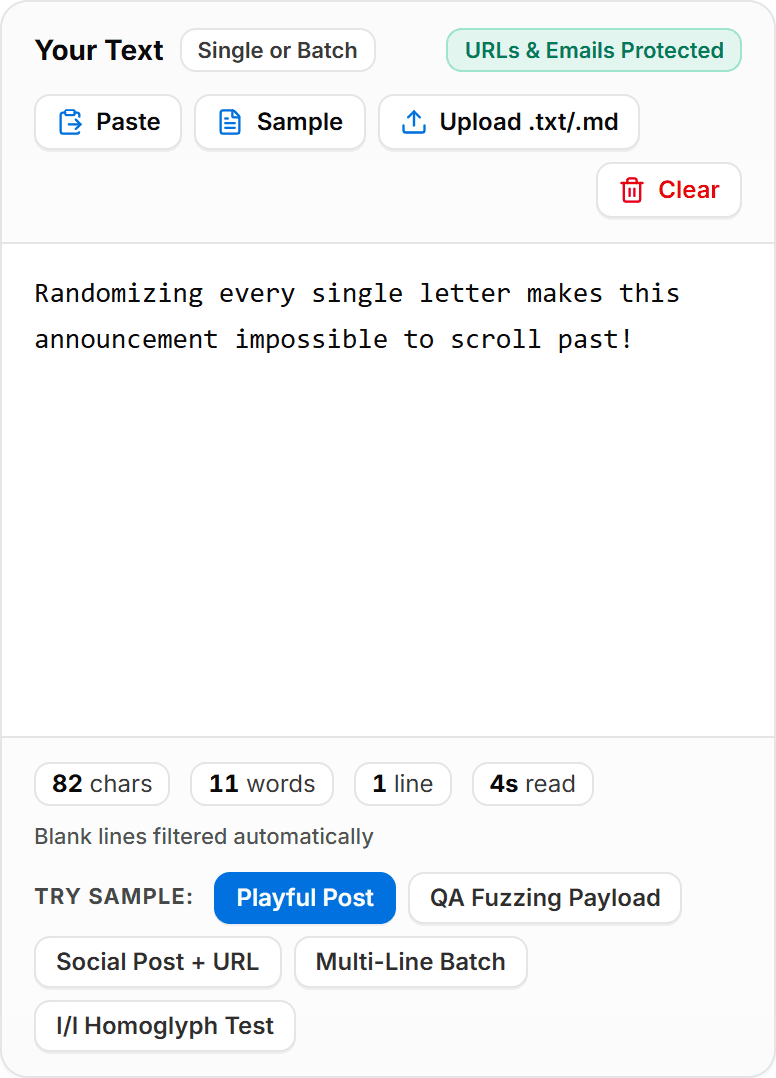
Enter your headline, meme reply, or batch strings into the mobile input workspace. Real-time telemetry measures characters, words, lines, and reading time while URLs and email addresses are automatically protected.
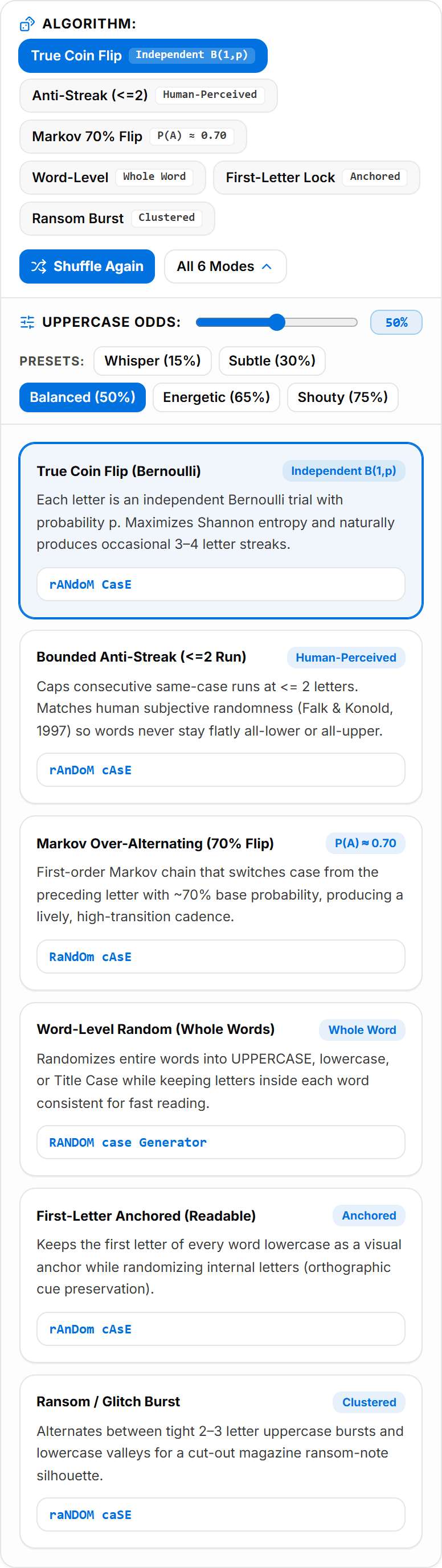
Choose from 6 specialized randomization algorithms ranging from pure Bernoulli coin flips to bounded anti-streak and word-level modes. Adjust uppercase probability from 0% to 100% with the smooth slider or 5 weighted shortcuts.
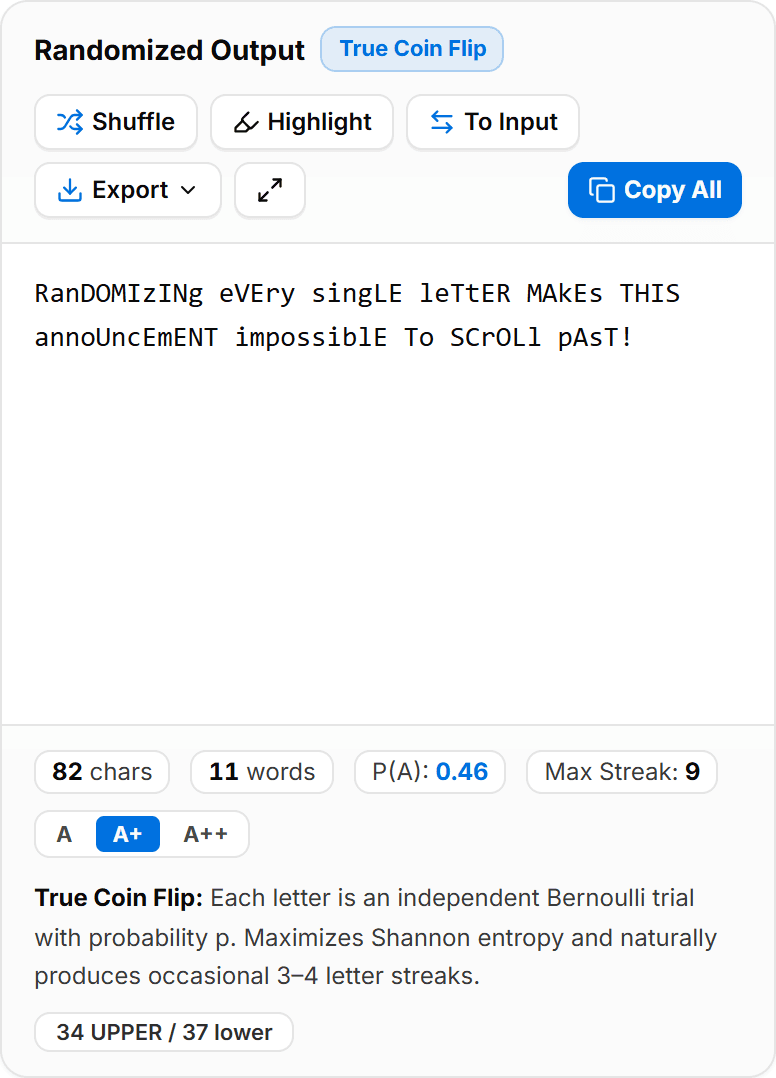
Watch your text transform in real time as you adjust odds or select algorithms. Inspect comprehensive empirical statistics comparing target probability against actual observed casing distribution.
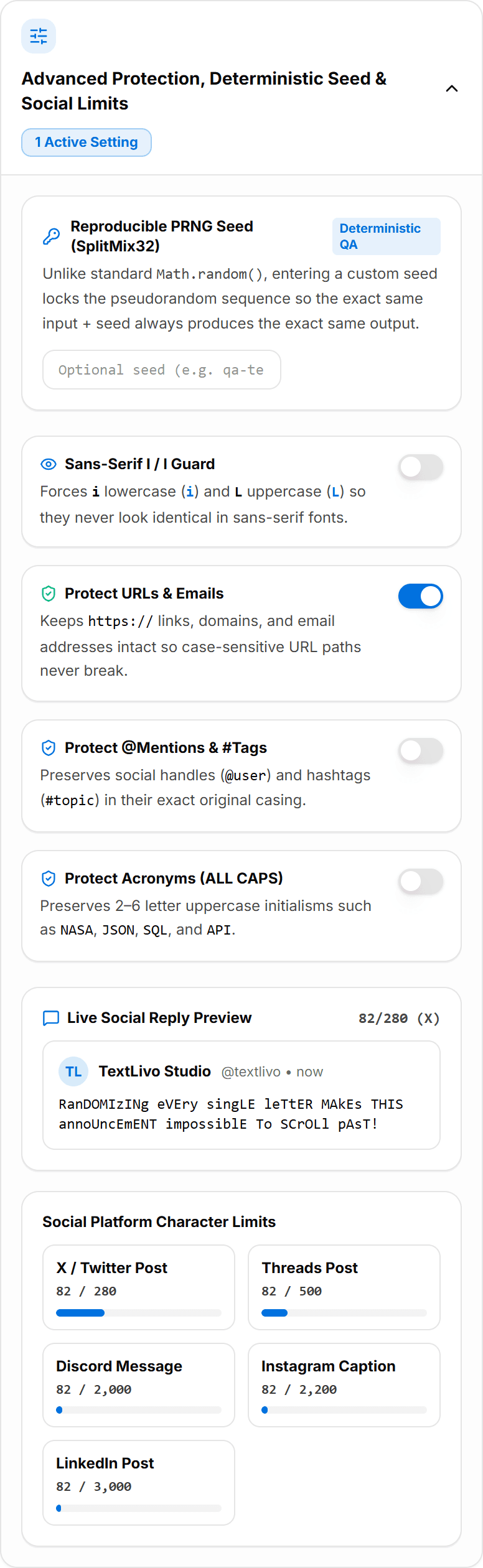
Expand advanced options to lock reproducible pseudorandom sequences using a 32-bit SplitMix32 PRNG seed. Activate the sans-serif I/l homoglyph guard to eliminate reading confusion in Arial, Roboto, and Helvetica.
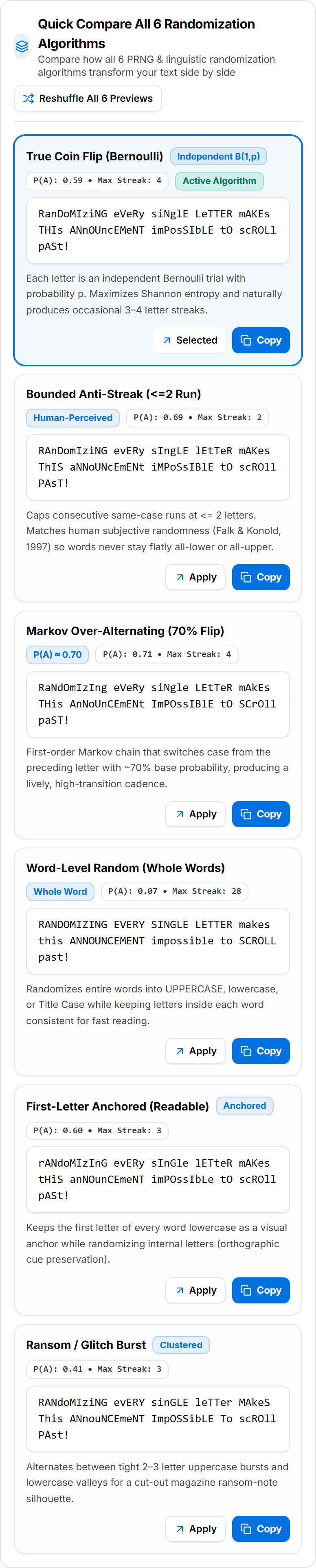
Review your exact text processed through all 6 algorithms side-by-side in real time. Compare empirical alternation rates, uppercase percentages, and visual rhythms before selecting your favorite style.
How Bernoulli coin flips, the clustering illusion (Gilovich, Vallone, & Tversky, 1985), and human alternation bias (Falk & Konold, 1997) shape mixed-case perception.
When users click a standard random case generator at 50% uppercase probability, they are often surprised to see an entire 4- or 5-letter word stay all-lowercase or all-uppercase (for example, “rANDOM case”). Psychologists and information theorists have studied this exact disconnect between objective statistical randomness and human subjective randomness for over five decades.
In an independent Bernoulli sequence of n = 20 letters at p = 0.50, the mathematical probability of seeing at least one streak of 4 or more identical-case letters is over 82%. As Gilovich, Vallone, & Tversky (1985) demonstrated in Cognitive Psychology, human observers systematically misinterpret these natural chance clusters as non-random streaks.
Given n letters and r same-case runs, the empirical probability of alternation is P(A) = (r - 1) / (n - 1). While a fair coin yields P(A) = 0.50, Falk & Konold (1997) (Psychological Review) proved that humans perceive a binary sequence as “maximally random” only when it over-alternates at P(A) ≈ 0.60–0.70.
As shown by Coltheart & Freeman (1974) and fMRI studies of the left ventral occipitotemporal Visual Word Form Area (VWFA) (Wimmer et al., 2016), unpredictable mid-word case switches disrupt multiletter bigram features and increase lexical encoding load—giving random case its chaotic, jarring visual energy.
Why a professional randomizer needs more than a single coin-flip loop—compare the mathematical rule, alternation rate, and ideal workflow for each mode.
Each letter is an independent Bernoulli trial with probability p (default 0.50).
Expected P(A) = 2p(1-p) = 0.50 • Max Entropy (1.0 bit/char)
Best for: Unbiased statistical randomization, differential case-sensitivity fuzzing, and raw coin-flip chaos.
Independent coin flip with a hard cap of <= 2 consecutive same-case letters.
Empirical P(A) ≈ 0.62–0.68 • Max Streak = 2
Best for: Eliminates accidental 4–5 letter streaks so short words never remain accidentally all-lowercase or all-uppercase.
Each letter switches case from the previous letter with ~70% base transition probability.
Empirical P(A) ≈ 0.68–0.72 • Models human negative recency
Best for: Mimics human-typed 'random' capitalization (Falk & Konold, 1997) and SpongeBob mocking cadence.
Assigns entire words to UPPERCASE, lowercase, or Title Case based on probability p.
Preserves intra-word visual word form (VWFA) recognition
Best for: Playful social captions and headlines where individual words must remain fast and effortless to read.
Locks every word-initial letter in lowercase while randomizing internal letters (<=2 streak).
Preserves word-initial fixation anchor (Peressotti et al., 2003)
Best for: Stylized usernames, bios, and long sentences that balance chaotic interiors with clean word boundaries.
Alternates between 2–3 letter uppercase micro-bursts and lowercase valleys.
Empirical P(A) ≈ 0.40 • High visual block contrast
Best for: Cut-out magazine ransom-note aesthetics, glitch art headers, and bold display typography.
How browser PRNGs (xorshift128+ vs. seeded SplitMix32), case-sensitivity fuzzing, and homoglyph guards work under the hood.
Modern JavaScript engines (V8 in Chrome/Edge, SpiderMonkey in Firefox, JavaScriptCore in Safari) implement Math.random() using xorshift128+ with a 2^128 - 1 period, but the ECMAScript specification provides no way to seed it. Our studio pairs an FNV-1a string hash with a 32-bit SplitMix32 PRNG so you can either shuffle freely or lock a deterministic seed for reproducible output.
While DNS domain names are case-insensitive (RFC 4343), URL paths and query strings (e.g., /Docs/v2) are case-sensitive on Linux/POSIX servers and CDNs. Our tokenizer isolates URLs and emails in Unicode Private Use Area sentinels before randomizing letters, and optionally disambiguates I (U+0049) vs. l (U+006C).
Software engineers use seeded random-case strings to test case-insensitive SQL collations, email/username normalization, and WAF filter rules. Need strict 1:1 rhythmic alternation instead of probabilistic randomization? Switch to our Alternating Case Generator or convert across all 31 standard writing, editorial, and code naming formats in our Case Converter.
Answers to common questions about Bernoulli probability, anti-streak randomization, PRNG seeds, and URL protection.
True Coin Flip: Each letter is an independent Bernoulli trial with probability p. Maximizes Shannon entropy and naturally produces occasional 3–4 letter streaks.
Compare how all 6 PRNG & linguistic randomization algorithms transform your text side by side
Each letter is an independent Bernoulli trial with probability p. Maximizes Shannon entropy and naturally produces occasional 3–4 letter streaks.
Caps consecutive same-case runs at <= 2 letters. Matches human subjective randomness (Falk & Konold, 1997) so words never stay flatly all-lower or all-upper.
First-order Markov chain that switches case from the preceding letter with ~70% base probability, producing a lively, high-transition cadence.
Randomizes entire words into UPPERCASE, lowercase, or Title Case while keeping letters inside each word consistent for fast reading.
Keeps the first letter of every word lowercase as a visual anchor while randomizing internal letters (orthographic cue preservation).
Alternates between tight 2–3 letter uppercase bursts and lowercase valleys for a cut-out magazine ransom-note silhouette.
